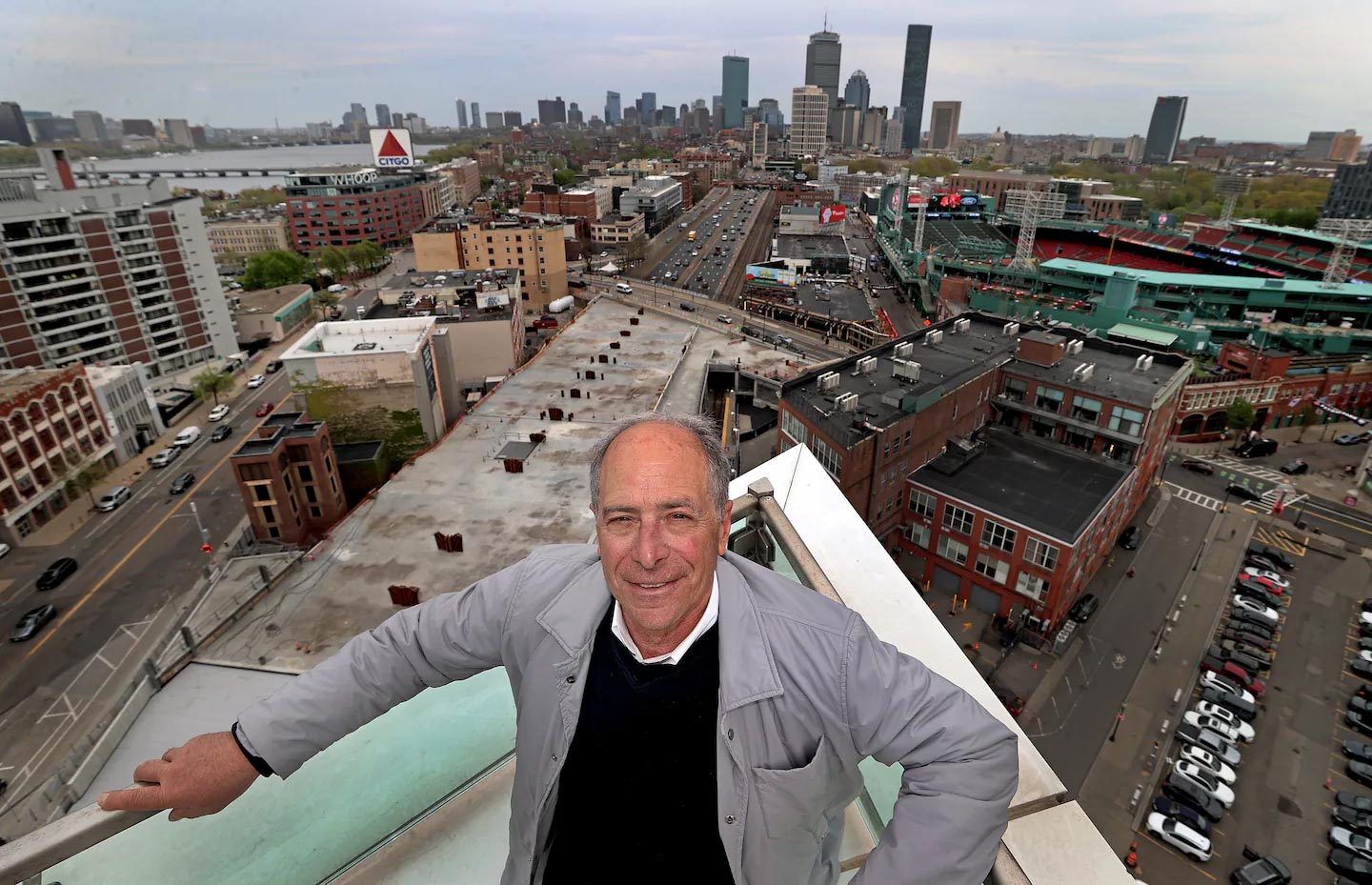

Stand with John Rosenthal atop his 15-story apartment complex in the Fenway, and it’s hard not to be swept up in the panorama — even if you’ve visited every skyscraper in the city.
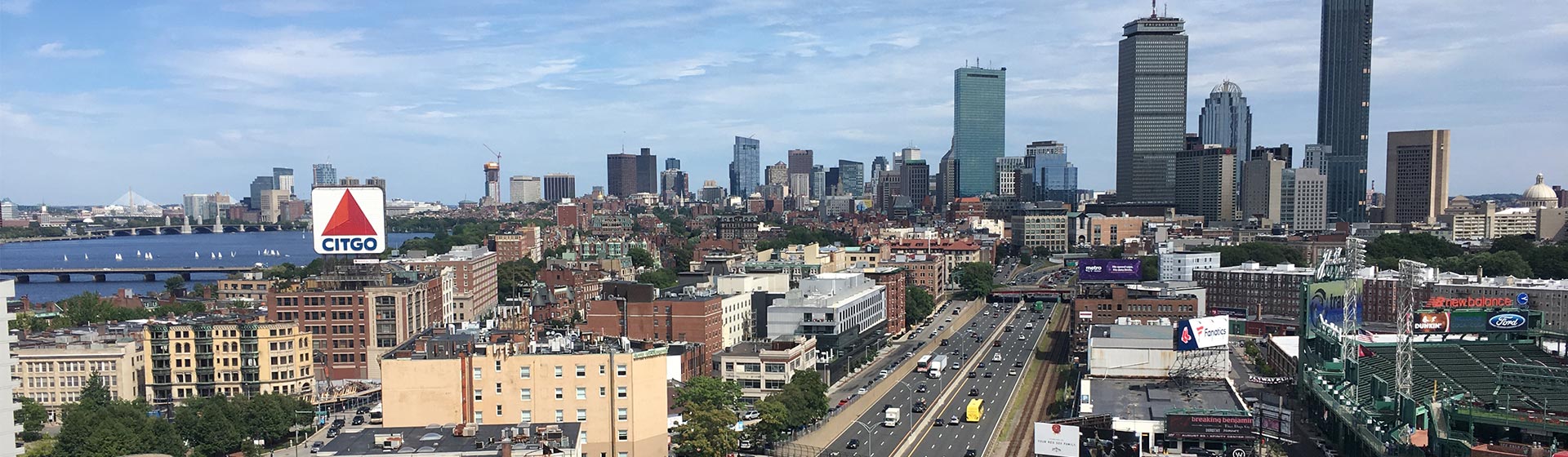
From left to right, you see the pillars of Greater Boston’s economy. Kendall Square’s labs and university halls. The Financial District towers off in the distance. The Back Bay skyline. The Longwood Medical Area. In the foreground: Fenway Park’s Green Monster, outfield, grandstands.
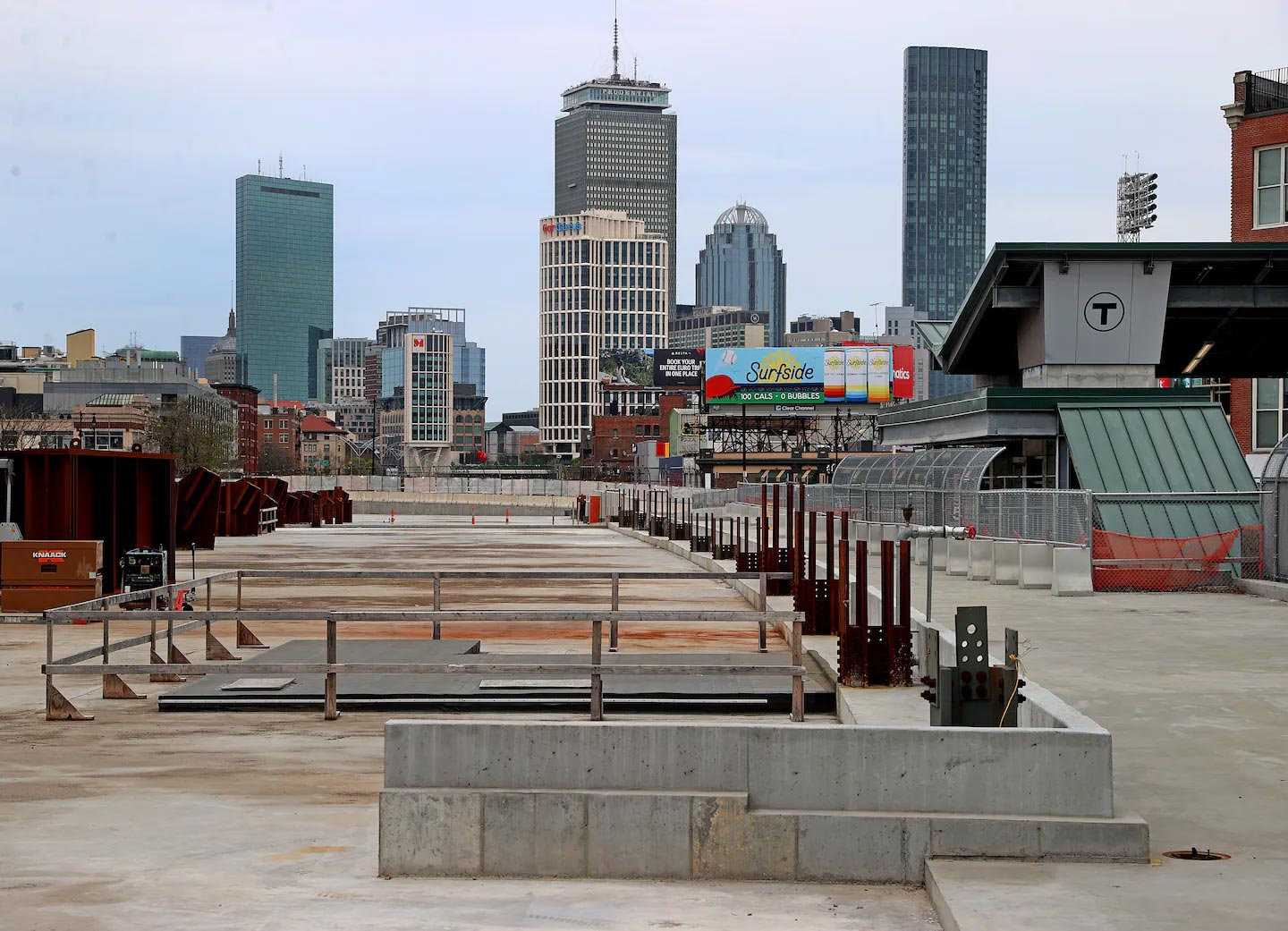
And just down below, right at street level, two acres of concrete: the biggest platform to go over the Mass. Turnpike since Copley Place in the 1980s. With the recent hookup of electric utility connections, the long-awaited Fenway Center deck over the highway is finally done.
How Rosenthal got here, though, is a story as long as the turnpike itself — one that involves at least two mayors, five governors, countless meals at Eastern Standard, that stolen base by Dave Roberts, and even a friendship between a black Labrador retriever and an English bulldog.
Rosenthal’s trek began in 1992, while running his family’s real estate business. He acquired the two-story parking garage on Lansdowne Street, in the Green Monster’s shadow. The garage became lucrative for Rosenthal and his business partners with around-the-clock traffic from hospital workers, baseball fans, and nightclub revelers. Rosenthal also hoisted a 252-foot-long gun-violence prevention billboard on its side facing the turnpike, bringing national attention to that cause.
A ski buddy suggested that Rosenthal contact the Mass. Turnpike Authority about internal discussions concerning “air rights” opportunities to privately develop land and air above the highway.
This was in the late 1990s, when the authority was consumed with the Big Dig a few miles down the pike. Rosenthal eventually persuaded the MTA (later subsumed by MassDOT) to put three air rights “parcels” out to bid, including one right behind the garage. His team was the sole bidder.
The money from the garage helped pay for these development efforts. Finally, Rosenthal had thought he had a proposal for an air-rights deck with two residential towers that would satisfy then-mayor Tom Menino in the fall of 2004, when the Red Sox won the World Series.
The new Sox owners declared they would stay put, ending years of speculation about the ballpark’s future. Putting up towers behind the Green Monster was suddenly no longer tenable at City Hall. (Sox principal owner John Henry now owns the Globe as well.)
So Rosenthal pivoted. What about another air rights parcel, across Brookline Avenue? (His partnership later sold the garage to the Sox, after winning the team’s support as well as permits for the new concept.) This new site had 2.5 acres of terra firma, and 2 acres of air.
Building on the dirt was relatively easy — at least once Rosenthal navigated a lawsuit from a nearby landowner and built a new state-funded commuter rail stop. It’s now home to Bower, a $240 million, 312-unit luxury complex developed with what is now known as Green Cities Co., above the Lansdowne station.
Building over the busy highway and rail line? That was never going to be easy. The deck alone would cost almost as much as the apartment building had. Rosenthal needed an investor with deep pockets, willing to bet big on Boston. Like a billion dollars big.
A chance meeting in the mid-2010s with a Gloucester neighbor, whose bulldog Aldo was friends with Rosenthal’s Lab Moxie, led to an introduction to Alan Gold, a life-sciences real estate entrepreneur in California. After launching Alexandria Real Estate Equities and then BioMed Realty, Gold was putting together a new venture and he wanted it to have a Boston footprint like its predecessors. Rosenthal and Gold hit it off at Eastern Standard, the Kenmore Square restaurant where Rosenthal once held court (and which reopened at Bower).
Along with Gold’s venture, IQHQ, Rosenthal reached a deal with MassDOT in 2020 to develop the two acres of air via a 99-year lease. All $55 million was paid upfront. Crews led by contractor J.F. White worked around the clock for months — driving steel piles more than 200 feet below the ground and laying the decking on top — all while cars rushed by on the Pike.
Now, we wait a little longer. The deck is done, but it sits empty until IQHQ can line up leases for key tenants, which would finance two big lab-and-office buildings planned for it.
At 69, Rosenthal has been through several economic cycles. Although the lab market imploded in the past three years, Rosenthal says he and IQHQ remain bullish about their prospects.
This is the heart of the country’s foremost life sciences cluster, after all, a fact clear to anyone who joins Rosenthal on that rooftop with its panoramic view of the city.
Something else comes into focus up there: the power of patience and persistence when developing real estate in Boston.